Flame retardant, fire resistant or LSZH? Cable fire standards
IEC 60332, IEC 60331, BS 6387, IEC 60754 and IEC 61034 test different things. What each standard proves, where it is required and how to specify it correctly.
By Xinya editorial team
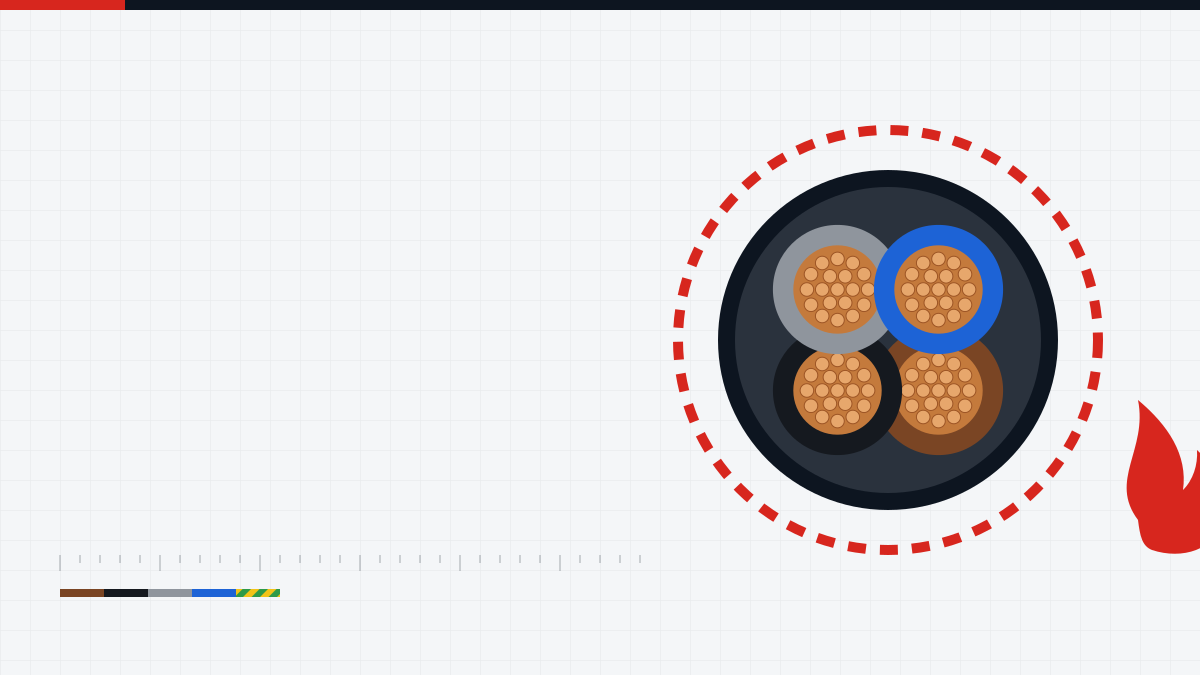
"Fire cable" can mean three different properties. Mixing them up is a common reason for rejected submittals on metros, tunnels, hospitals and high-rise projects.
1. Flame retardant — the cable does not spread fire
- IEC 60332-1-2: a single vertical cable exposed to a 1 kW flame must self-extinguish within set limits. Almost every modern power cable passes this.
- IEC 60332-3 (categories A, B, C, D): a bunch of cables on a vertical ladder burns for 20 or 40 minutes; the char must stay below 2.5 m. Category A has the most combustible material per metre and is the hardest. This is the test that matters for cable risers and trays.
2. Fire resistant — the circuit keeps working in a fire
Circuit integrity for life-safety systems: fire pumps, smoke extraction, emergency lighting, alarms.
- IEC 60331-21: cable energised at rated voltage in a 750 °C flame, typically for 90 minutes.
- BS 6387 CWZ: C = 950 °C for 3 hours, W = flame plus water spray, Z = 950 °C with mechanical shock.
- BS 8491 covers larger cables above 20 mm diameter.
Fire-resistant cables use mica-glass tape over the conductor (or mineral insulation). They are only as good as the installation: use fire-rated supports and glands.
3. Low smoke, zero halogen (LSZH) — the smoke is less harmful
- IEC 60754-1/-2: halogen acid gas, pH ≥ 4.3 and conductivity ≤ 10 µS/mm for halogen-free compounds.
- IEC 61034-2: smoke density in a 3 m cube, typically ≥ 60 % light transmittance.
LSZH matters where people must escape through enclosed spaces and where corrosive gas would damage equipment.
4. How to specify
State each property separately, for example: "0.6/1 kV Cu/mica/XLPE/LSZH, fire resistant to IEC 60331-21 and BS 6387 CWZ, flame retardant to IEC 60332-3-22 Cat. A, halogen-free to IEC 60754-1/-2, low smoke to IEC 61034-2." In the EU, cables in buildings also need a CPR class to EN 50575 (for example B2ca-s1a,d1,a1).
Send us your specification. We confirm which tests apply, which reports we provide for your project and the matching cable construction.