Choosing medium-voltage XLPE cable: U₀/U, screen size and bonding
What 8.7/15 kV or 18/30 kV really means, how the earthing system changes the voltage rating, why the copper screen must match the earth-fault current, and how single-core cables are bonded.
By Xinya editorial team
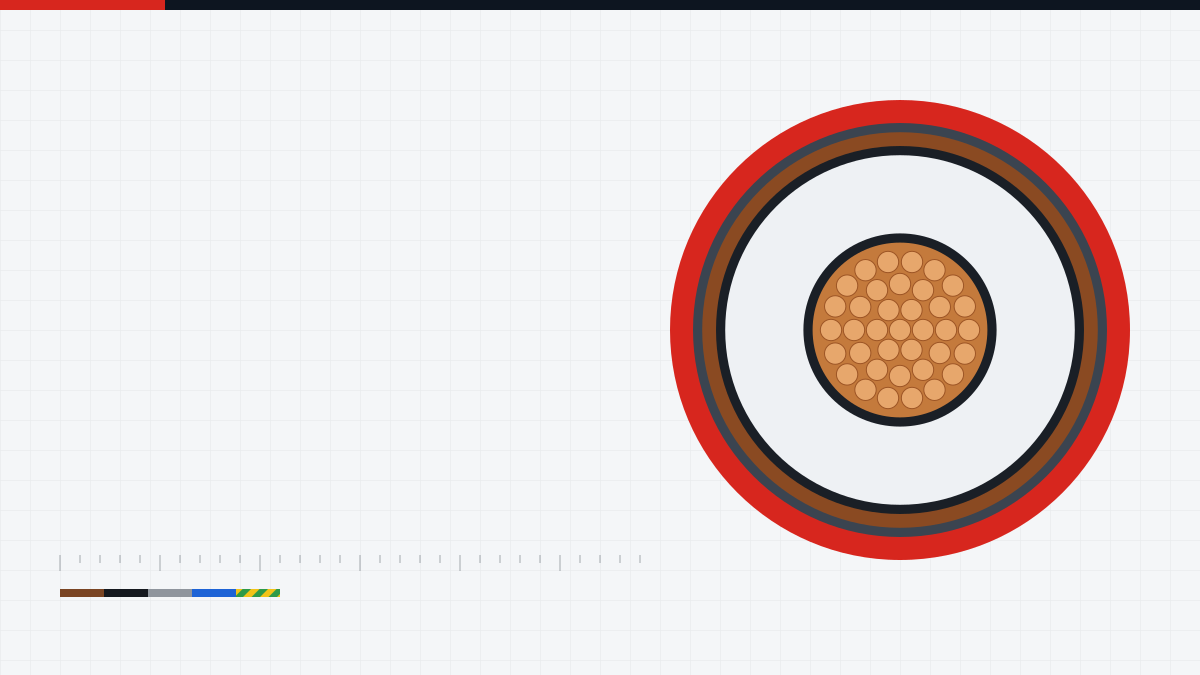
Medium-voltage cables to IEC 60502-2 are specified by more than the system voltage. Four decisions matter most.
1. Voltage rating U₀/U (Um)
U₀ is the voltage between conductor and screen, U between phases, Um the highest system voltage: for example 8.7/15 (17.5) kV, 12/20 (24) kV and 18/30 (36) kV.
The earthing system decides U₀. Where earth faults are cleared quickly (categories A and B) U₀ ≈ U ÷ √3. In unearthed or resonant-earthed networks where a fault may persist for hours (category C), choose the next higher U₀ — for an 11 kV category C system that means 8.7/15 kV instead of 6.35/11 kV.
2. Conductor and insulation
Copper or aluminium, class 2 compacted (IEC 60228). The conductor screen, XLPE insulation and insulation screen should be extruded in one pass (triple extrusion) on a CCV line — this keeps the interfaces clean and is what gives low partial discharge. IEC 60502-2 requires no detectable discharge above 10 pC at 1.73 U₀ in the routine test, together with a voltage test of 3.5 U₀ for 5 minutes.
3. Metallic screen sized to the fault
The copper wire or tape screen carries the earth-fault current until protection trips. Size it with the adiabatic equation I² t = k² S² for your fault level and clearing time — typical screens are 16, 25 or 35 mm². Too small a screen is one of the most common specification errors on renewable collector networks.
4. Single-core cables: armour and bonding
- Single-core AC cables need non-magnetic armour (aluminium wire, AWA) — steel wire armour on one core heats up from induced currents.
- Screens bonded at both ends carry circulating currents on large sections. Single-point bonding or cross-bonding removes them, but needs sheath voltage limiters and a design check.
- For buried routes specify longitudinal and radial water blocking (swellable tapes, aluminium-laminated sheath).
Before you order
Send us the system voltage and earthing, the load or conductor size, fault level and duration, route length and installation method. We return a cable data sheet, the screen calculation and a drum plan that avoids unnecessary joints.